
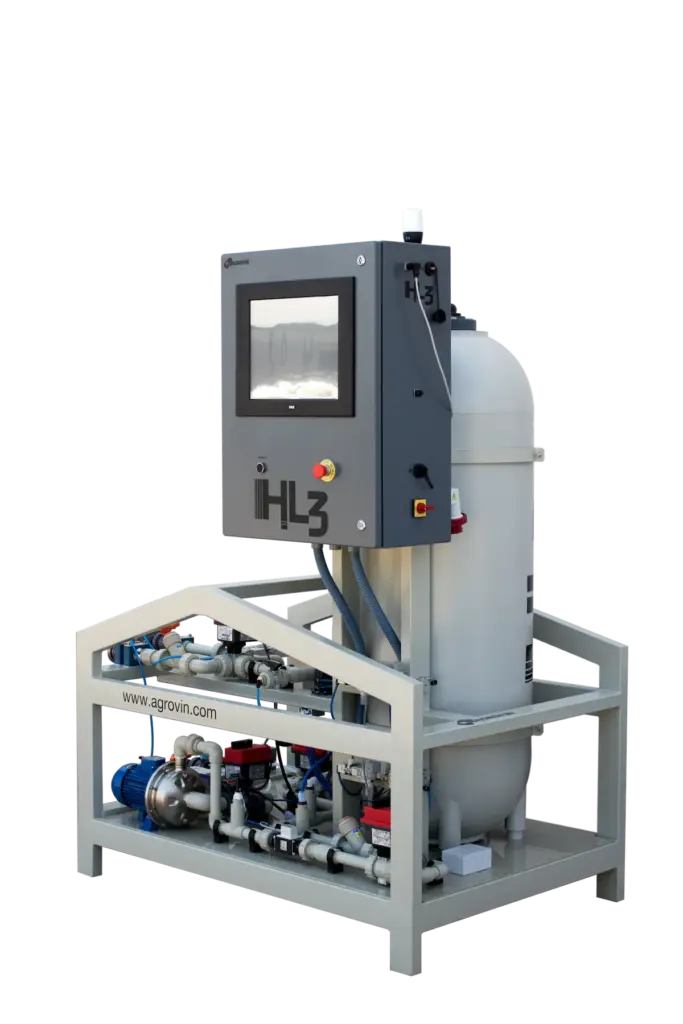
HL3
Removal of geosmin and undesirable compounds from musts and wines
HL3 is a system based on highly selective adsorbent resins designed to reduce certain undesirable compounds present in musts and wines.
Its primary application is the reduction of geosmin—which is responsible for moldy or earthy organoleptic off-flavors—through an automated, rapid treatment process that can be tailored to the needs of each winery.
In addition, the technology can significantly reduce polyphenolic concentrations—including both phenolic acids and flavanols—as well as riboflavin (vitamin B2), which is primarily responsible for the so-called “light-induced off-flavor” in white wines.
This is how HL3 works
The adsorbent polymers selected for HL3 technology are characterized by their high adsorption surface area, which results from their porosity, as well as by their pore size, which is selective for certain molecules such as geosmin and the most oxidative polyphenols.
During treatment, the must or wine passes through the adsorbent polymer at a flow rate that was previously defined and optimized during the system’s development. The solid-liquid contact between the polymer and the product promotes the selective adsorption of certain compounds based on their physicochemical properties and polarity, allowing for a more selective action than other treatments such as PVPP or activated carbon.
Unlike ion-exchange resins, this process does not involve an exchange of components with the liquid phase.
Once the adsorption stage is complete, HL3 performs the cleaning and desorption process to remove compounds adhering to the resins, preparing them for a new operating cycle.
Proceso de adsorción
Proceso de desorción
Advantages
Geosmin removal
Reduces the concentration of geosmin associated with musty-earthy off-flavors, improving the organoleptic quality of the treated must or wine.
Reduction of polyphenolic compounds
Helps reduce the concentration of certain polyphenolic compounds, including oxidized and potentially oxidizable compounds in musts and wines.
Reduction of vegetal compounds
It reduces certain C6-type compounds associated with vegetal notes and characteristics.
Continuous Treatment
The system allows the process to be integrated into the winery’s regular workflow, adjusting flow rates and processing times based on the treatment objective.
Selective adsorption
Its porosity, pore size, and adsorption surface area ... make it possible to select compounds with different polarities.
Reusable resins
The cleaning and desorption process allows the resins to be regenerated for subsequent cycles.
Results
Geosmin removal
Muscat wine
Riboflavin removal
Airén wine
Source: tests conducted in collaboration with the UCLM Research Group on Oenology and Natural Products
Features
Significant advantages for installation and operation:
- Automatic: The various stages of treatment are managed by the unit itself, simplifying operations throughout the entire process.
- Standalone: The HL3 operates as a standalone unit and requires no special installations or auxiliary equipment for integration into the winery.
- Adaptable: The user can adjust flow rates and processing times based on the product, the initial concentration, and the desired outcomes.
- Traceable:: The system allows for tracking of the treated product and the solutions used during the different stages of the process.
- Compact: Its design facilitates the integration of the unit into various winery environments and processes.
Models, throughput, and consumption
Available HL3 models. Performance and consumption rates.
*Capacities and cycle volume may vary depending on the quantities of compound to be removed and the desired objectives.
Un proceso automático en cinco etapas
01. Drenaje del agua
Preparación del sistema antes de iniciar el tratamiento.
02. Adsorción
Paso del mosto o vino a través de las resinas adsorbentes para la retención selectiva de los compuestos objetivo.
03. Producto de enjuague
Recuperación del producto contenido en el sistema tras la etapa de adsorción.
04. Lavado
Limpieza y desorción de las resinas para recuperar su capacidad de adsorción.
05. Aclarado
Preparación final de las resinas para iniciar un nuevo ciclo de trabajo.
Request more information
Contact us by completing this form and we will get back to you as soon as possible. At AGROVIN, we want to hear the stories from our collaborators. Tell us yours and indicate the reason for your email.
Information request
Please enter your details below.